
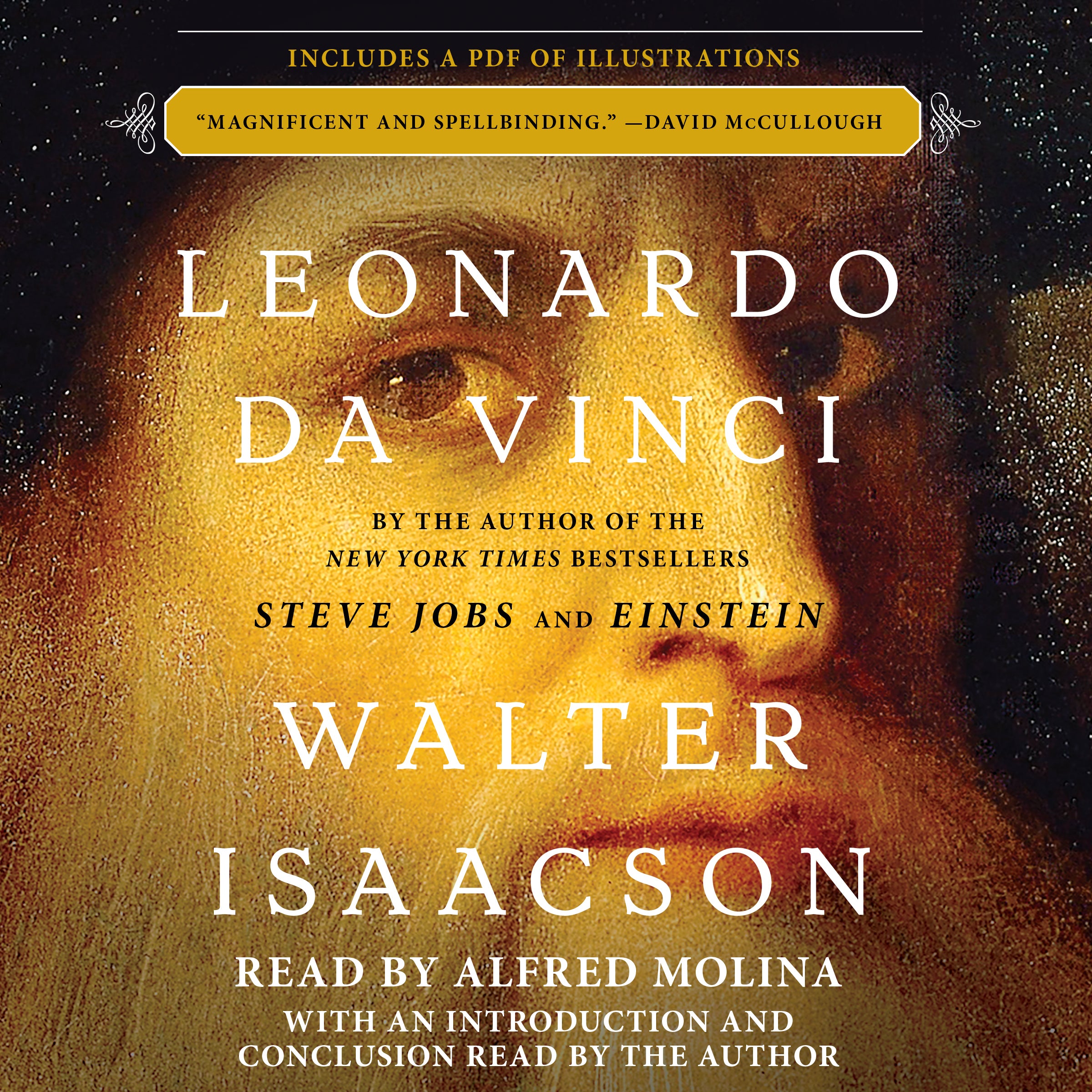
Leonardo da Vinci
“Alfred Molina’s narration is easy to follow…The author’s sometimes detailed passages seem natural, and Molina’s cultured accent adds to the listening pleasure without seeming like an affectation. His fluency with Italian names helps keep the reading flowing. The PDF is a visual treat and is referenced throughout the work, so listeners will want to refer to it regularly to get the full benefit of the author’s analysis. Nonetheless, the reading stands on its own. Winner of the AudioFile Earphones Award.”
AudioFile
Longlisted for the Andrew Carnegie Medal for Excellence in Nonfiction
Winner of an AudioFile Earphones Award
A BookPage Top Pick for November
A Los Angeles Times Pick for Audiobooks
An Audible.com bestseller
A #1 New York Times bestseller
A Library Journal Editor’s Pick of Most Borrowed Bestsellers
A New York Times audio bestseller
Based on thousands of pages from Leonardo da Vinci’s astonishing notebooks and new discoveries about his life and work, Walter Isaacson “deftly reveals an intimate Leonardo” (San Francisco Chronicle) in a narrative that connects his art to his science. He shows how Leonardo’s genius was based on skills we can improve in ourselves, such as passionate curiosity, careful observation, and an imagination so playful that it flirted with fantasy.
He produced the two most famous paintings in history, The Last Supper and the Mona Lisa. With a passion that sometimes became obsessive, he pursued innovative studies of anatomy, fossils, birds, the heart, flying machines, botany, geology, and weaponry. He explored the math of optics, showed how light rays strike the cornea, and produced illusions of changing perspectives in The Last Supper. His ability to stand at the crossroads of the humanities and the sciences, made iconic by his drawing of Vitruvian Man, made him history’s most creative genius.
In the “luminous” (Daily Beast) Leonardo da Vinci, Isaacson describes how Leonardo’s delight at combining diverse passions remains the ultimate recipe for creativity. So, too, does his ease at being a bit of a misfit: illegitimate, gay, vegetarian, left-handed, easily distracted, and at times heretical. His life should remind us of the importance to be imaginative and, like talented rebels in any era, to think different. Here, da Vinci “comes to life in all his remarkable brilliance and oddity in Walter Isaacson’s ambitious new biography…a vigorous, insightful portrait” (The Washington Post).
Praise