
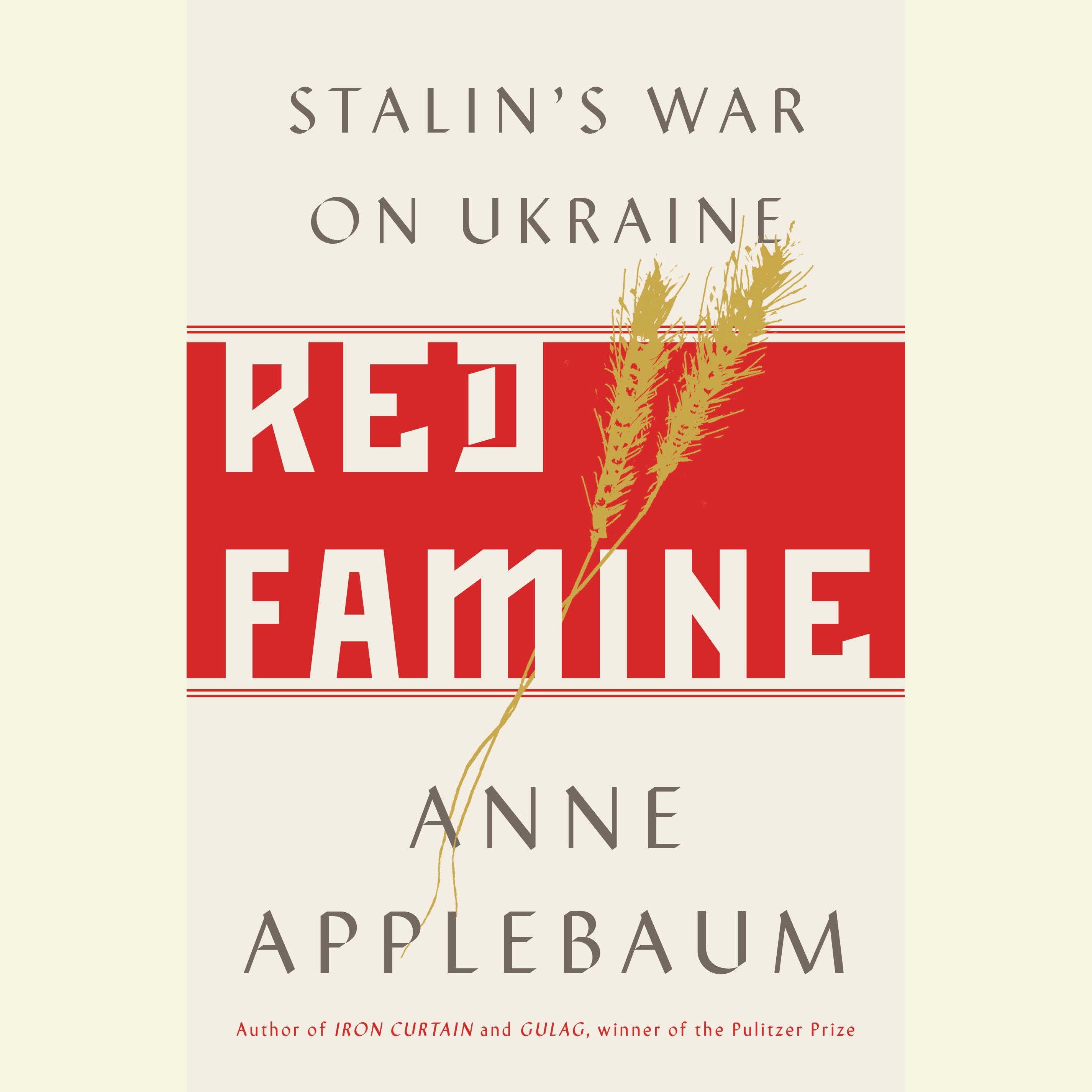
Red Famine
Read by
Suzanne Toren
Release:
10/10/2017
Runtime:
17h 47m
Unabridged
Quantity:
Applebaum's account will surely become the standard treatment of one of history’s great political atrocities . . . She re-creates a pastoral world so we can view its destruction. And she rightly insists that the deliberate starvation of the Ukrainian peasants was part of a larger [Soviet] policy against the Ukrainian nation . . . To be sure, Russia is not the Soviet Union, and Russians of today can decide whether they wish to accept a Stalinist version of the past. But to have that choice, they need a sense of the history. This is one more reason to be grateful for this remarkable book.
Timothy Snyder, Washington Post
Shortlisted for the 2018 Cundill Prize in Historical Literature
A London Economist Best Book of the Year
Among shortlisted titles for Cundill History Prize, 2018
Among shortlisted titles for Cundill History Prize, 2018
Among shortlisted titles for Cundill History Prize, 2018
Among shortlisted titles for Cundill History Prize, 2018
AN ECONOMIST BEST BOOK OF THE YEAR
From the author of the Pulitzer Prize-winning Gulag and the National Book Award finalist Iron Curtain, a revelatory history of one of Stalin's greatest crimes—the consequences of which still resonate today
In 1929 Stalin launched his policy of agricultural collectivization—in effect a second Russian revolution—which forced millions of peasants off their land and onto collective farms. The result was a catastrophic famine, the most lethal in European history. At least five million people died between 1931 and 1933 in the USSR. But instead of sending relief the Soviet state made use of the catastrophe to rid itself of a political problem. In Red Famine, Anne Applebaum argues that more than three million of those dead were Ukrainians who perished not because they were accidental victims of a bad policy but because the state deliberately set out to kill them.
Applebaum proves what has long been suspected: after a series of rebellions unsettled the province, Stalin set out to destroy the Ukrainian peasantry. The state sealed the republic’s borders and seized all available food. Starvation set in rapidly, and people ate anything: grass, tree bark, dogs, corpses. In some cases, they killed one another for food. Devastating and definitive, Red Famine captures the horror of ordinary people struggling to survive extraordinary evil.
Today, Russia, the successor to the Soviet Union, has placed Ukrainian independence in its sights once more. Applebaum’s compulsively readable narrative recalls one of the worst crimes of the twentieth century, and shows how it may foreshadow a new threat to the political order in the twenty-first.
From the author of the Pulitzer Prize-winning Gulag and the National Book Award finalist Iron Curtain, a revelatory history of one of Stalin's greatest crimes—the consequences of which still resonate today
In 1929 Stalin launched his policy of agricultural collectivization—in effect a second Russian revolution—which forced millions of peasants off their land and onto collective farms. The result was a catastrophic famine, the most lethal in European history. At least five million people died between 1931 and 1933 in the USSR. But instead of sending relief the Soviet state made use of the catastrophe to rid itself of a political problem. In Red Famine, Anne Applebaum argues that more than three million of those dead were Ukrainians who perished not because they were accidental victims of a bad policy but because the state deliberately set out to kill them.
Applebaum proves what has long been suspected: after a series of rebellions unsettled the province, Stalin set out to destroy the Ukrainian peasantry. The state sealed the republic’s borders and seized all available food. Starvation set in rapidly, and people ate anything: grass, tree bark, dogs, corpses. In some cases, they killed one another for food. Devastating and definitive, Red Famine captures the horror of ordinary people struggling to survive extraordinary evil.
Today, Russia, the successor to the Soviet Union, has placed Ukrainian independence in its sights once more. Applebaum’s compulsively readable narrative recalls one of the worst crimes of the twentieth century, and shows how it may foreshadow a new threat to the political order in the twenty-first.
Release:
2017-10-10
Runtime:
17h 47m
Format:
audio
Weight:
0.0 lb
Language:
English
ISBN:
9780525498186
Publisher:
Penguin Random House
Praise